A Volubilis day from Fes is a journey to an archaeological site, not simply a train ride to Meknes with the last part left to chance. A rental car can connect the destinations, but it also introduces collection, parking and a driver responsible for the return. Start by deciding whether you want the ruins alone, a separate Moulay Idriss stop or a more ambitious day involving Meknes. Each addition needs time on foot and its own arrival plan. This guide keeps those choices separate so the car supports the visit rather than filling the day with unnecessary transfers.
Keep Fes, Meknes, Moulay Idriss and Volubilis distinct
Volubilis is an archaeological site associated with the Meknes region, while Moulay Idriss is a nearby town with a separate identity and visitor experience. UNESCO lists Volubilis as World Heritage and describes its surviving ancient remains. These facts establish why it is worth investigating as a destination; they do not turn the surrounding places into one attraction with a shared entrance or admission arrangement.
Save separate map locations for the ruins, any town stop and the place where you are staying in Fes. If a quotation says Meknes excursion, ask whether it actually includes Volubilis and how long is allocated there. If you are driving, set the archaeological visitor entrance as the destination rather than the centre of a nearby town. A day can become unnecessarily complicated when one broad regional label hides several distinct journeys, parking decisions and walks. Decide the priorities before choosing transport.
Choose a day trip or an onward journey before renting
A return to the same Fes accommodation allows you to travel with a smaller day bag and leave the main luggage securely at the property. An onward journey towards another city means carrying everything and arranging a different arrival or return. Those are different rental requirements. Do not choose an inexpensive short period and later assume it includes a different-city handback or an extra evening of driving.
The Morocco one-way rental guide explains the questions to resolve when collection and return differ. For a Fes-based day, confirm the actual collection location and hours in the offer; this article does not claim a Vrenty Car branch or a supplier desk at your riad. If a different-city service is requested, obtain confirmation of the destination, fee and receiving appointment. Keep the planned sightseeing independent of an unconfirmed rental amendment, so you can still choose a simpler transport arrangement if necessary.
Arrange a collection point you can actually reach
If staying in or near the medina, ask the accommodation for a practical vehicle meeting point rather than sending only its postal address. A place reachable on foot may not be an appropriate car entrance. Confirm where the supplier will wait, how you reach it with any luggage and whether the proposed handover has room for an inspection. Do not assume that a general hotel-delivery request includes navigating every narrow street to the door.
Keep the accommodation's directions and the supplier's appointment together. If they describe different meeting places, resolve the difference before paying for a service that matters to the trip. The Morocco car catalogue is a starting point for available offers, not proof that every displayed car can be collected in Fes. Check the location choices and the particular supplier's answer. A clear handover outside a difficult access area can be more useful than a vague promise of delivery somewhere near the hotel.
Compare driving with rail plus a confirmed local transfer
A train journey to Meknes does not by itself deliver you to Volubilis. If considering that option, check the current rail journey and then arrange the onward transport, waiting and return. Do not leave the final leg as an assumption that a vehicle will be available at the price or time you need. Ask whether a transfer quotation is one-way, return or includes waiting while you visit the site.
The Morocco train versus rental comparison helps compare complete journeys. A rental can be useful when several rural or outlying stops are genuinely part of the plan. Rail with an arranged transfer can suit travellers who prefer not to drive and have a straightforward meeting arrangement. Compare door-to-door logistics, not just the fare against a daily car rate. Include reaching the station or rental pickup, the site visit, the return and the flexibility to change the day if access or weather becomes unsuitable.
Use a current route and leave room for the final approach
Check the driving route from your actual Fes meeting point shortly before departure. Review the final approach to the visitor entrance as well as the broad journey towards the Meknes region. A navigation estimate does not include every delay, break or parking decision, and this guide does not guarantee a specific travel time. Save enough information to identify the destination if mobile data becomes unreliable.
Do not follow a shorter-looking track without knowing that it is a permitted route suitable for your rental. The supplier's road restrictions apply even when the map shows a connection. If the approach becomes uncertain, stop somewhere safe and clarify rather than continuing under pressure to meet an estimated arrival time. Keep the driver focused on the road and let a passenger handle navigation where possible. A comfortable arrival matters more than reproducing a journey time quoted in a travel account from another season.
Check admission and parking without borrowing an old tariff
Before leaving, seek current visitor information for the archaeological site, including opening, last entry and the admission category applicable to your group. This guide does not verify a universal current ticket price or parking fee. A price in an old review or a tour advertisement may describe a different date, visitor category or package. Clarify any authorised charge before paying and retain the receipt.
On arrival, follow official signs and staff directions for parking and the entrance. Do not infer permission from a row of vehicles in an archival photograph. Leave access routes and turning space clear, record where the car is parked and take what you need for the walk. If offered a guide or another service, ask who provides it, the agreed scope and the price before beginning. Admission, parking and interpretation are separate questions unless the actual arrangement explicitly combines them.
Make the ruins the main part of the visit
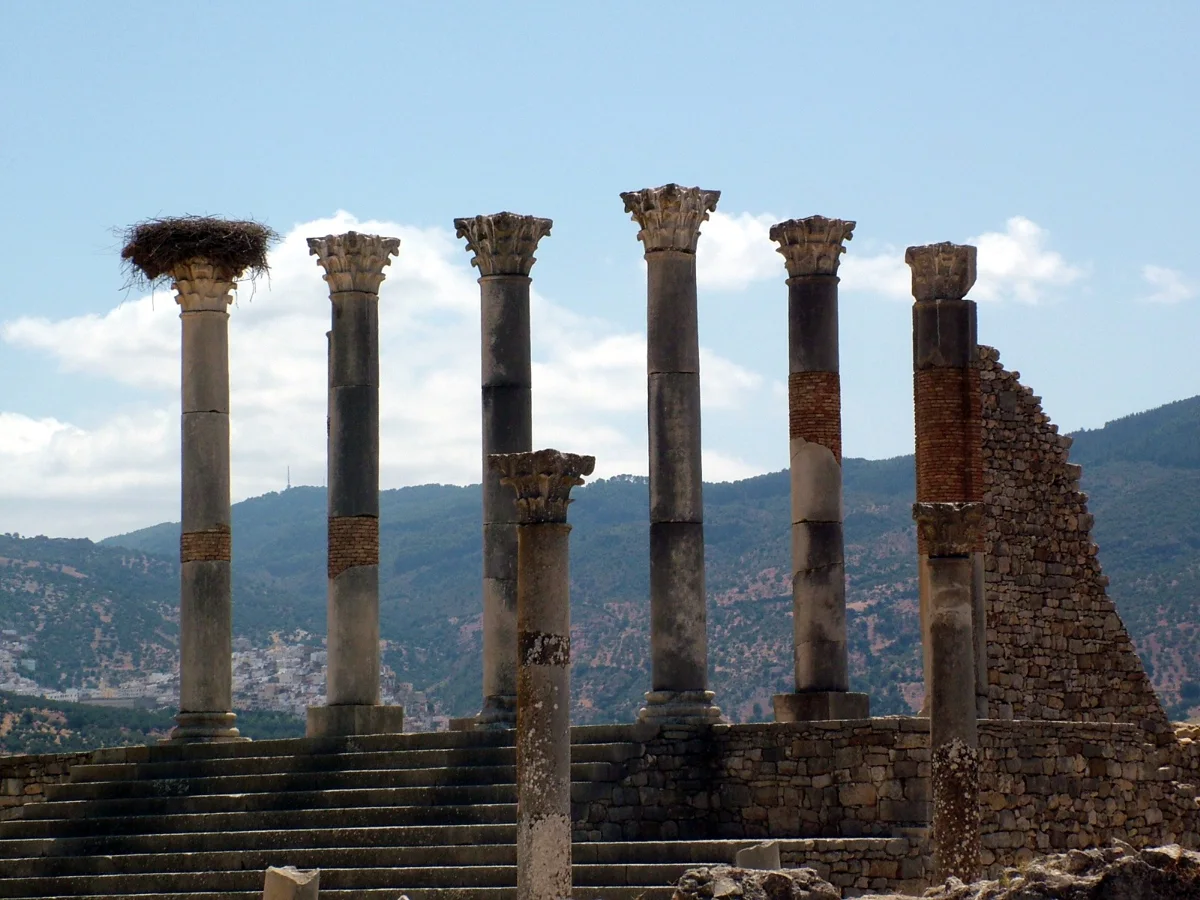
Volubilis is an extensive archaeological landscape, not a single building to photograph from the car. UNESCO describes surviving ancient structures in an agricultural setting. Use the current visitor map and interpretation to choose a route through accessible areas. The remains, including monuments and mosaics where accessible, are better approached as a walking visit with time to look rather than a brief stop between two towns.
Choose a few priorities with the group instead of trying to complete every feature mentioned in a long historical account. Stay within permitted visitor routes and respect barriers protecting fragile areas. Do not climb remains or step into a closed section for a clearer photograph. The image in this guide is archival and does not establish today's conservation work, access or conditions. If a particular part of the site is essential to your interest, check it before travel rather than assuming every area described online is currently available.
Plan an outdoor walk for the actual group
Take water, suitable footwear and protection for the weather rather than treating the visit like an indoor museum. Decide how much walking everyone wants and where you will meet if people move at different speeds. Do not assume shade, seating or refreshments will appear at exactly the point they are needed. Leave enough energy for the walk back to the car and the onward journey, not only for reaching the most distant feature.
For a visitor with mobility needs, ask about the actual entrance and usable routes before committing to the day. A large site should not be described as step-free without specific confirmation. If the group includes children, keep the route adaptable and take breaks before tiredness turns the return into a problem. Reducing the visit is a reasonable choice when conditions are uncomfortable. Having a rental gives flexibility over departure; it does not require you to stay until every planned part of the archaeological circuit is complete.
Add Moulay Idriss as its own town visit
Moulay Idriss is close enough in the regional itinerary to be considered alongside Volubilis, but it is not simply another section of the ruins. Decide what you want from the stop: a meal, a walk through permitted public areas or a particular view. Identify an appropriate vehicle approach and parking arrangement separately. Do not assume access to religious or private buildings, and follow local signs and guidance about where visitors may enter.
If the town visit matters as much as the archaeological site, give it real time rather than squeezing it into the return. Consider the walking involved and whether everyone still wants another stop after the ruins. Keep one part optional when the day is becoming long. Avoid adopting a tour seller's compressed itinerary without checking how it fits your group's pace. A thoughtful visit to two places is different from driving to both names and leaving too quickly to understand either one.
Decide whether Meknes belongs in this same day
Meknes has its own city visit, and adding it after Volubilis and Moulay Idriss creates another arrival and parking problem. Ask whether you have time for a meaningful stop rather than merely passing through. The Moroccan tourism board presents the city and its surroundings as multiple experiences, not a requirement to complete them all between breakfast and a return to Fes. A separate Meknes day may fit a slower itinerary better.
If the plan includes rail for another part of the trip, confirm the exact station and connection independently. Do not assume a sightseeing stop ends at the platform or that every train serves the place named in a general itinerary. For a self-drive return, keep the car's location and your exit route clear before walking into a busy area. The Morocco driving and parking guide provides broader planning context. When time is short, omit an extra city stop rather than rush both it and the return.
Choose the vehicle and payment arrangement before the itinerary expands
Check passenger space, luggage capacity, transmission and essential equipment in the selected car. A vehicle adequate for a day bag may not be suitable if you change the plan into an onward journey with all luggage. Confirm approved drivers and the supplier's collection requirements. A premium class does not resolve an uncertain meeting point, while a low price does not make an unsuitable vehicle workable for the group.
Separate the online advance, the balance and any deposit, including the accepted method for each. If a payment requirement matters to your ability to collect, obtain an answer tied to the actual offer before paying. Do not infer no-card collection or absence of responsibility from a no-deposit label. Keep the rental documents and assistance contact accessible during the outing. An attraction booking or a guide's suggestion does not alter the vehicle agreement, permitted roads or return appointment you accepted with the supplier.
Set the return decision before starting the last walk
Before entering the ruins, choose a latest time to be back at the car that protects the return to Fes or the agreed onward destination. Include walking, a rest break and any fuel or handback requirement. Reassess that margin before adding Moulay Idriss or Meknes. A slower journey or a particularly rewarding visit is a reason to simplify the remaining day, not to drive under pressure to complete every originally listed stop.
If your rental ends that evening, confirm the actual receiving point and time. Ask the supplier in advance if an extension becomes necessary; a delayed sightseeing day does not create automatic permission. Keep handback evidence and receipts until the account is settled. The useful Volubilis plan is one you can explain clearly: where you collect, which site is the priority, which stop is optional and where the journey ends. That clarity makes both self-drive and an arranged transfer easier to compare and much easier to enjoy.
Questions & answers
Can a train from Fes take me directly to Volubilis?
Do not treat a rail journey to Meknes as arrival at the ruins. Plan and confirm the onward local transfer, waiting and return separately. Compare that complete arrangement with driving rather than comparing only a train fare with a car's daily rate.
Does this page confirm a rental desk in Fes?
No. Inspect the actual collection locations and supplier confirmation for the offer you choose. A destination guide is not proof of a Vrenty Car branch, a riad delivery service or a station desk. Give the supplier a precise, practical meeting point.
Should I include both Moulay Idriss and Meknes?
Only if the day allows meaningful visits and a comfortable return. They are separate destinations with their own walking and parking needs. Give Volubilis or another chosen place priority, then keep an extra stop optional rather than relying on an overfilled schedule.
Is Volubilis a quick stop beside the car?
Plan it as an outdoor archaeological walk. Check current access, bring what the group needs and allow time to return to the parking area. Driving there does not establish step-free routes or access to every feature described in historical material.